Many people who take Lyrica, or who have a urine test coming up, ask the same question: does Lyrica show up in a urine test, and for how many days can it be detected in urine?
This article explains how pregabalin leaves the body, what published studies say about its detection time and which factors affect that time.
What Is Lyrica?
Lyrica is the brand name of a medicine whose active ingredient is pregabalin. Doctors prescribe pregabalin to treat conditions such as epilepsy and pain caused by nerve damage (neuropathic pain). A urine test detects this active ingredient, which the body excretes, not the brand name of the medicine.
Does Pregabalin Show Up in a Urine Test?
The body barely metabolizes pregabalin, which means it converts almost none of it into other substances. According to the drug's FDA-approved prescribing information, about 90% of a dose leaves the body unchanged in the urine.[1] This makes urine a suitable sample for detecting pregabalin.
Whether a test shows pregabalin depends on which substances it screens for. Standard drug test panels, which screen for substances such as THC, cocaine, amphetamine and morphine, usually do not include pregabalin. To detect pregabalin use, you should use a test developed specifically for this substance.
How Long Does Pregabalin Stay in Urine?
How long pregabalin can be detected in urine varies from person to person, and published data on the question are limited. In a study published in 2013, pregabalin was detected in a healthy volunteer's urine for 56 hours after a single 75 mg dose and for 64 hours after a single 150 mg dose.[2]
The researchers compared their data with data from an earlier published study. Based on this comparison, in people with normal kidney function it is quite unlikely that pregabalin will be detected in urine 5 to 6 days after the last dose.[2] The drug's FDA-approved prescribing information gives a mean elimination half-life of 6.3 hours in people with normal kidney function.[1] The half-life is the time it takes for the amount of the drug in the body to fall by half.
These values were measured with laboratory methods and give a general idea. In a rapid test, the cut-off decides the result. The cut-off is the lowest concentration at which the test gives a positive result. Because this value differs from the measurement limit of laboratory methods, the detection time with a rapid test can be shorter or longer.
The cut-off of our Pregabalin Test is 500 ng/mL (500 nanograms per milliliter). Tests from other manufacturers may use a different value.[4]
Factors That Affect Detection Time
- Dose: At higher doses, pregabalin can be detected in urine for longer.
- Frequency of use: The volunteer in the study that measured detection time took only a single dose.[2] Data on detection time after regular use are limited, so this time may differ.
- Time since the last dose: The longer it has been, the lower the pregabalin concentration in urine.
- Kidney function: The rate at which pregabalin leaves the body is almost directly proportional to creatinine clearance, a measure of how well the kidneys filter the blood. When kidney function is reduced, the drug stays in the body longer.
- Urine concentration: Whether urine is dilute or concentrated affects the measured concentration. To balance this effect, the study used values corrected for creatinine, whose level reflects how concentrated the urine is.[2]
- Cut-off of the test: If the pregabalin concentration in the sample stays below the cut-off, the result is negative even if a small amount of pregabalin is present.
How Do You Use the Pregabalin Rapid Test?
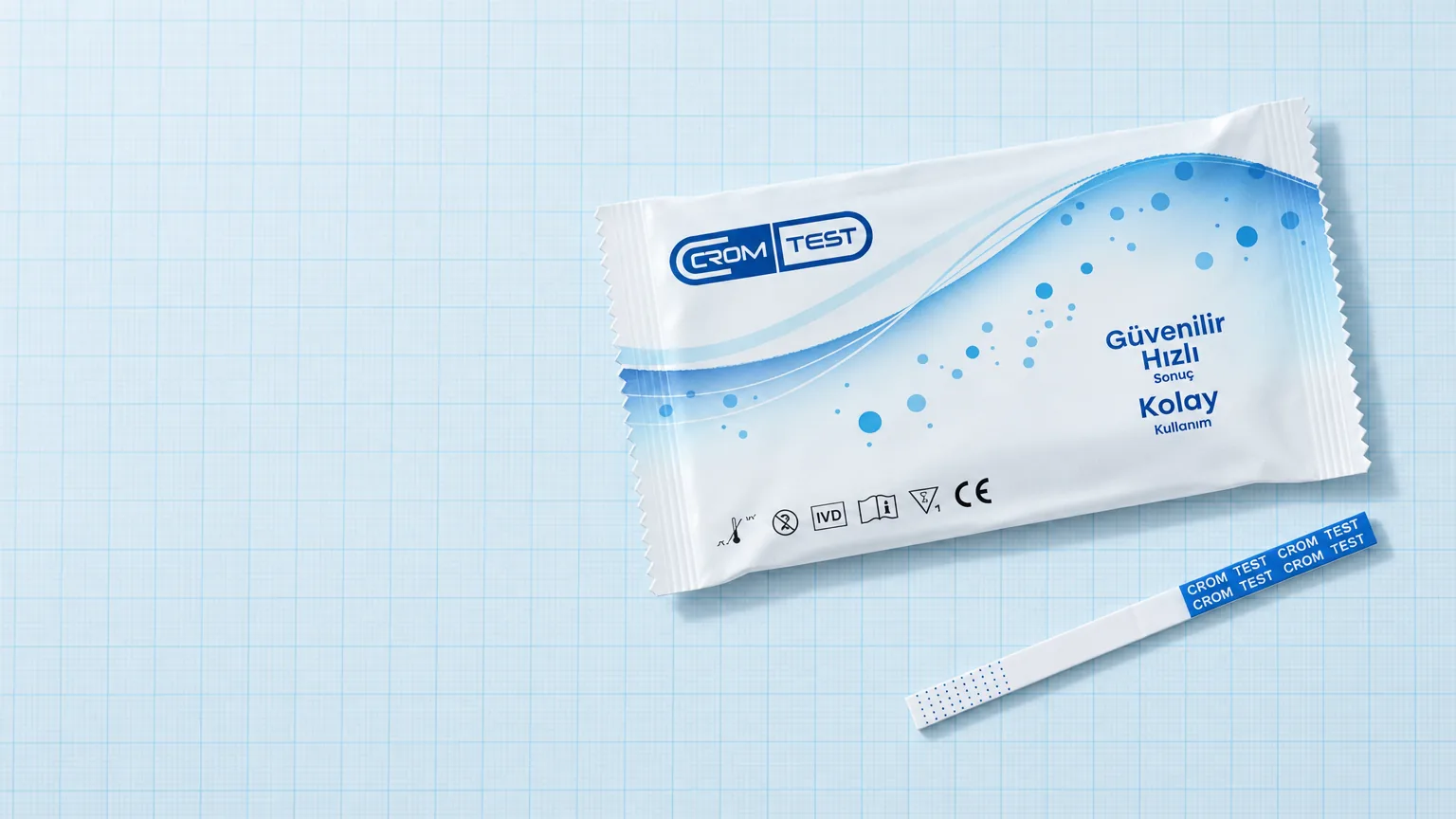
Our Pregabalin Test is an immunochromatographic (antibody-based) rapid test that works with a urine sample.[4]
- Collect the urine sample in a clean sample cup.
- Take the test strip out of its packaging, dip it into the urine up to the MAX line and wait 20 seconds.
- Place the test strip on a dry, flat surface and wait 5 minutes.
- Read the result from minute 5 onward. Do not evaluate the result after 10 minutes.
How Do You Read the Result?
- Negative: One line appears in the control (C) region and one in the test (T) region. Even if the line in the T region is faint, the result counts as negative.
- Positive: A line appears only in the control (C) region. This shows that the sample contains pregabalin above the cut-off.
- Invalid: No line forms in the control (C) region. In this case, repeat the test with a new test strip.
What Does a Positive Result Mean?
The rapid test is a qualitative screening test. The result shows whether the pregabalin concentration in the sample exceeds the cut-off. It gives no information about how much of the drug was taken. A definitive result requires a confirmation test with a method such as LC-MS/MS or GC-MS.
If you take pregabalin on your doctor's prescription, your test result may be positive. For this reason, you are advised to tell the organization doing the test, or the doctor who will assess the result, in advance that you take the medicine, and to keep your prescription with you.
Should I Stop Taking the Medicine Before the Test?
You are not advised to stop a medicine your doctor prescribed just because you are going to be tested. Stopping pregabalin suddenly can cause symptoms such as insomnia, nausea, headache and anxiety. In people with a seizure disorder such as epilepsy, seizures may become more frequent.
The drug's FDA-approved prescribing information recommends that, when treatment has to end, the dose be reduced gradually over at least one week. Always make the decision to stop the medicine or lower the dose together with your doctor.
Frequently Asked Questions
Does Lyrica show up on a standard drug test?
Standard drug panels usually do not cover pregabalin. To show Lyrica use, you need a test made specifically for pregabalin. The organization doing the test can tell you which substances it screens for.
How many days after the last dose can pregabalin be detected in urine?
In a study with a single volunteer, pregabalin was detected in urine for about two and a half days (56 to 64 hours) after a single dose. Based on the researchers' laboratory data, this time is unlikely to exceed 5 to 6 days in people with normal kidney function.[2]
Does the test result show how much of the drug was taken?
A rapid test does not measure quantity. It only shows whether the cut-off was exceeded.
For detection times of other substances in urine, see our article Which Substances Show Up in Urine Tests, and for How Long?
Conclusion
Pregabalin, the active ingredient in Lyrica, leaves the body largely unchanged in the urine, so a urine test can detect it. This requires a pregabalin-specific test, and the detection time depends on factors such as dose, frequency of use and kidney function.
If you are looking for a suitable test kit to screen urine for pregabalin:
View the Pregabalin TestSources
- Pfizer. LYRICA (pregabalin) FDA-approved prescribing information, NDA 021446, 2018 (Reference ID 4252171), sections 1, 5.3 and 12.3.
- Spigset O, Westin AA. Detection times of pregabalin in urine after illicit use: when should a positive specimen be considered a new intake? Ther Drug Monit. 2013;35(1):137-140. doi:10.1097/FTD.0b013e31827789dd
- ARK Diagnostics. ARK Pregabalin Urine Assay instructions for use, Rev. 02, 2017. For this immunoassay, which is used in laboratories, confirmation of preliminary results by GC-MS or LC-MS/MS is recommended.
- CROM TEST. Pregabalin Test (CRT-SP-PRE-U05) product information, cut-off 500 ng/mL, 2026.
This content is for informational purposes only. Authorized laboratory analysis should be the basis for any clinical decision-making process.