"Knockout drops" (Turkish: bayıltıcı damla) is an everyday name for substances slipped into someone's drink without their knowledge that cloud consciousness. GHB (gamma-hydroxybutyrate), ketamine and Rohypnol are the ones named in this context.[1][2][3] If you feel unexpectedly sleepy, dazed or confused after a drink, go to someone you trust and call 112.
This article covers what GHB, Rohypnol and ketamine are and how they act on the body, what to do if you suspect your drink was spiked, how to protect yourself, and how to check a drink before you drink it.
What are knockout drops?
"Knockout drops" or "knockout pills" is not the name of a drug. The phrase groups the substances that are secretly added to drinks and can cause drowsiness, confusion or memory loss. Some of them are hard to notice in a drink: GHB is colourless and almost odourless.[4]
Adding a substance to someone's drink without their knowledge puts their health and safety directly at risk. This article is written to help people who may face this, and the people around them, protect themselves.
GHB, Rohypnol and ketamine: effects and risks
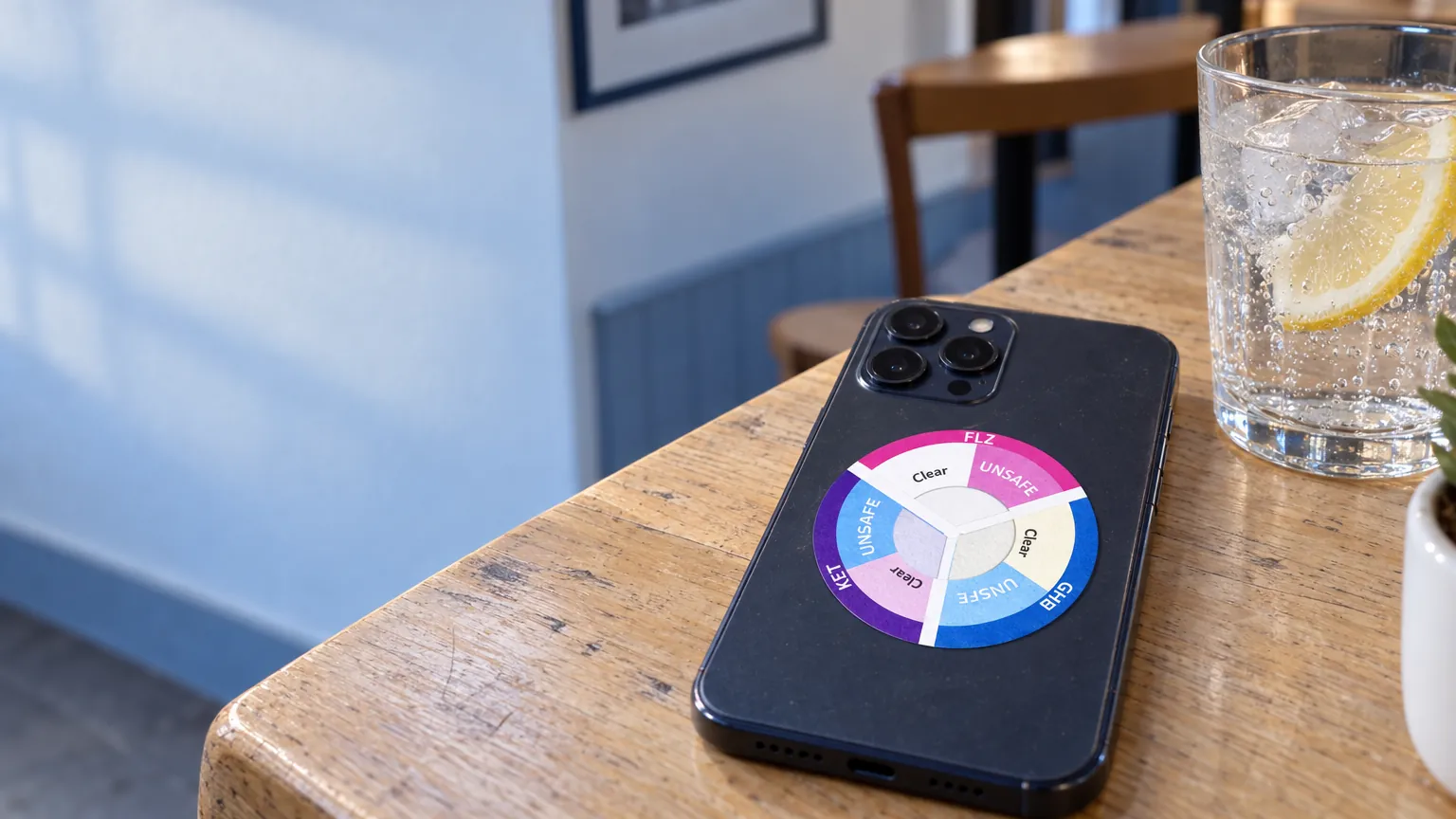
The three substances screened by the Drink Safety Test belong to different drug classes and act differently. What they share is that they can impair consciousness and movement within a short time and make it hard to remember afterwards what happened while they were acting.[1][2][3] On the test label, ketamine is shown as KET and flunitrazepam (Rohypnol) as FLZ.[5]
What is GHB?
GHB depresses the central nervous system. Under the name sodium oxybate it is prescribed in some countries to treat narcolepsy, sudden sleep attacks during the day that a person cannot control.[1] It has been under international control by the United Nations since 2001.[6] It usually comes as a colourless liquid, is almost odourless and may taste slightly salty.[4]
- Effect: it starts 15 to 30 minutes after intake and can last 1 to 6 hours depending on the dose.[7] A low dose looks like alcohol intoxication.[6] The person may become sleepy and nauseous, and memory can be impaired.[1]
- At high doses: loss of consciousness, seizures, a slow heartbeat, markedly slowed breathing, low body temperature, vomiting and coma. An overdose can kill.[1] The gap between an effective and a toxic dose is small, so a slightly larger dose can already cause impaired consciousness and coma.[6]
- With alcohol: GHB's toxic effects can increase when it is taken with alcohol or other psychoactive substances.[6]
- Misuse: GHB has been used in sexual assaults and other crimes because it causes memory loss and makes the person passive.[1] Regular use can lead to dependence. Stopping suddenly can cause withdrawal with confusion, tremor and seizures.[4]
What is Rohypnol (flunitrazepam)?
Rohypnol is the brand name of a benzodiazepine whose active ingredient is flunitrazepam.[8] Some countries prescribe it for insomnia. The tablet can be crushed or dissolved and added to a drink.[2]
- Effect: it slows the central nervous system. It causes drowsiness, muscle relaxation and an inability to remember afterwards what happened while it was acting (anterograde amnesia). Judgement and reaction are impaired. Confusion, slurred speech, loss of coordination, weakness and headache can follow. Some people become aggressive or very restless.[2]
- Half-life: the half-life is the time it takes for the amount of a substance in the blood to fall by half. It is not the total time the substance stays in the body. Flunitrazepam leaves the body slowly; its half-life in blood is about 20 hours.[9] How long the effect lasts and how long a test can find the substance are separate questions; detection times are covered below.
- With alcohol: at high doses, especially with alcohol or other central nervous system depressants, it can cause heavy sedation, loss of consciousness, a slow heartbeat and breathing depression severe enough to kill.[2]
- Misuse: in sexual assaults, flunitrazepam has mostly been added to the victim's alcoholic drink without their knowledge to stop them resisting. Regular use can cause physical dependence.[2]
What is ketamine?
Ketamine is a dissociative anaesthetic used for short anaesthesia in humans and animals. One form of ketamine, esketamine, is used as a nasal spray for treatment-resistant depression. Outside medical control it comes as a powder or liquid and can be mixed into drinks.[3]
- Effect: taken by mouth, it usually starts working within 20 minutes to 1 hour.[10] The person feels detached from their surroundings and their body, sight and hearing are distorted, and hallucinations can occur. Restlessness, confusion, rapid involuntary eye movements, dilated pupils, muscle stiffness and nausea can also appear.[3] Ketamine can also speed up the heart and raise blood pressure.[10]
- At high doses: the person may be unable to move and may feel that their mind has left their body. Because ketamine dulls pain, they can be injured without noticing or be exposed to harm from others.[10] An overdose can cause unconsciousness and dangerously slow breathing.[3]
- With alcohol: taking ketamine with alcohol, benzodiazepines or opioids is dangerous.[10]
- Misuse: ketamine has also been used to facilitate sexual assault.[3] Regular use can cause memory problems, depression and severe damage to the bladder and urinary tract. Long-term users can become psychologically dependent.[10]
Substances added to drinks are not limited to these three. In forensic examinations of reported sexual assaults, alcohol and benzodiazepines were found more often than GHB.[6] A large amount of alcohol can also produce a similar picture.
How can you tell if your drink has been spiked?
GHB is colourless and almost odourless, so looking at or smelling the drink is not enough.[4] A clearer warning sign is a change that comes on quickly and is out of proportion to what you drank. If you feel very drunk, strange or unwell after only a little alcohol, take it seriously.[11]
- What you may notice in yourself: sudden sleepiness, dizziness, nausea, trouble thinking or speaking, losing your balance, and gaps you cannot remember.[1][7]
- What others may notice: slurred speech, staggering, slow or confused answers, falling asleep suddenly, or unexpected restlessness and aggression.[2]
Call 112 straight away if any of these is present: the person cannot be woken or does not respond when you call out, their breathing has slowed markedly, they are having a seizure, or they are vomiting while their consciousness is clouded.[1]
These signs alone do not prove that something was added to a drink, and they do not show which substance was taken. Alcohol or other health problems can look similar. If you are in doubt, do not wait for the symptoms to ease; follow the steps below.
What to do if you suspect your drink was spiked
If you suspect spiking, getting safe comes before looking for proof. The responsibility always lies with the person who added the substance. Do not hesitate to ask for help or to report it.
If you notice symptoms in yourself
- Do not stay alone. Tell a friend you trust or a member of staff right away. Do not go anywhere with someone you have just met or do not know well.[11]
- Leave safely. Ask someone you trust to take you out of the venue. If you feel seriously unwell, go to hospital, not home.[11]
- Call 112 if you have symptoms or they are getting worse quickly. Tell the team what you drank and that you suspect something was added.[11]
- Keep the drink. If you can, keep what is left of it together with the glass and hand it to the police. Glasses, bottles and drink residue can be used in a forensic examination.[9]
- Have someone stay with you until the effects wear off, including at home. The effects can take several hours to pass.[11]
If you see these signs in a friend
- Do not leave them alone. Stay with them and do not let them leave with someone they do not know.[11]
- If they do not respond when you call out or their breathing does not look normal, call 112 immediately and follow the operator’s instructions. Stay with them until help arrives.
- Tell the emergency team what they drank, how much, and when the symptoms started.[11]
At the hospital and the police
At the hospital, tell the medical team you suspect something was added to your drink and ask for blood and urine samples. Some substances leave the body in less than a day, and even a delay of an hour or two in taking a blood sample can mean the substance is no longer found.[9] Go even if time has passed. Forensic guidelines recommend a urine sample within 5 days of the incident and, if possible, a blood sample within the first 48 hours.[9]
If you suspect a substance was added to your drink without your knowledge, report it to the police as soon as possible.[11] If you suspect you were sexually assaulted, try not to wash or change your clothes before you go, because this can destroy forensic evidence. You can still go to the police if you have washed.[12]
How long can these substances be detected?
How long a substance acts and how long it can be detected are different periods. GHB leaves the body quickly: its half-life in blood is about 30 to 50 minutes and it can be detected in urine for only about 3 to 10 hours.[7] For benzodiazepines such as flunitrazepam, detection depends on the method. Rapid immunoassays may fail to detect some benzodiazepines after 2 to 3 days, while confirmation methods such as LC-MS/MS can detect them for 4 days or longer.[9] Ketamine can be detected in urine for a few days.[10]
These figures are a rough guide and vary with the amount taken, the person and the method of analysis. None of them is a reason to delay: the earlier the sample is taken, the more likely the substance is found.[9]
Whether these substances are in the body of a person with symptoms is established by laboratory analysis of samples. The medical and forensic staff decide which sample to take.[9] The test described below is made for checking a drink before it is drunk. For how long other substances can be detected in urine, see our article Which substances show up in a urine test, and for how many days?.
How to protect yourself from knockout drops
These precautions for a night out reduce the risk but do not remove it.[11]
- Plan where you are going and how you will get home, and make sure your phone is charged.
- Go with others, not alone, to a bar, club or party, and look out for each other.
- Keep your drink in sight. Buy it yourself and watch it being made. Do not leave it unattended when you dance or go to the toilet.
- Do not accept drinks from strangers and do not drink from someone else's glass.
- Do not drink anything that tastes or looks different.
- Think twice before leaving a venue with someone you have just met.
If you doubt a drink that was left unattended or offered to you, you can check it with the test below before drinking.
How to use the Drink Safety Test
The Drink Safety Test is a single-use sticker test for when you doubt a drink that was left unattended or offered by someone else. It screens GHB, ketamine and Rohypnol in one test area, and the result is read from a colour change.[5] The steps:
Drink Safety Test5 tests · GHB, ketamine and Rohypnol · results in 1 to 3 minutes · product page in Turkish
View Product- Stick: remove the backing and stick the test label on the back of your phone or on a flat surface. Make sure the test spots are completely dry.
- Drop: put one drop of the drink in the centre of the test area.
- Wait for the test area to dry. This takes 1 to 3 minutes.[5]
How to read the result
The test area has separate spots for GHB, KET and FLZ. Read the result from the colour of these spots once the area is dry.
- No colour change: none of the three spots changes and they stay light. The test did not detect these three substances in the drink. A negative result does not prove the substance is absent.
- Positive: the GHB or KET spot turns blue, or the FLZ spot turns red-purple. Do not drink it.[5] If you can, keep the drink with its glass and report it to staff or the police.
A positive result is a qualitative screen: it shows that a substance is present, not how much, and on its own it does not prove an illegal substance is present. A definite result needs laboratory confirmation.[5] Our article What does a positive drug test mean? explains the difference between a rapid test and laboratory confirmation.
Limits of the test
- It screens only for GHB, ketamine and Rohypnol. A negative result does not mean the drink contains no other substance or is safe in every respect.
- Do not use it with dairy products, drinks containing milk, cream or oily liquids.
- Blue or red-purple drinks can cause a false positive.
- Results are for personal use and reference and do not replace medical or forensic assessment.[5]
Conclusion
Knockout drops is a name for substances added to a drink unnoticed that cloud consciousness. GHB, Rohypnol and ketamine can impair consciousness and movement within a short time and are more dangerous with alcohol. Sleepiness, dizziness and memory gaps out of proportion to what was drunk are important warning signs. If you suspect spiking, stay with someone, call 112, and ask for blood and urine samples early. A quick screen of a suspicious drink before drinking gives first information about GHB, ketamine and Rohypnol within minutes but does not cover other substances.
Drink Safety Test
5 tests per pack · GHB, ketamine and Rohypnol · results in 1 to 3 minutes. The product page is in Turkish.
Frequently asked questions
Are knockout drops and GHB the same thing?
Knockout drops is not the name of a specific substance. It is a general term for substances secretly added to drinks that cloud consciousness. GHB is one of them; ketamine and Rohypnol are named in the same context.
What is GHB and how long does it last?
GHB is a colourless, almost odourless central nervous system depressant.[1][4] Its effect starts 15 to 30 minutes after intake and can last 1 to 6 hours depending on the dose. Its toxic effects can increase with alcohol.[6][7]
What is Rohypnol?
Rohypnol is the brand name of a sleeping medicine containing flunitrazepam. It causes drowsiness, muscle relaxation and inability to remember what happened while it was acting. With alcohol it can depress breathing dangerously.[2]
What is ketamine?
Ketamine is a dissociative anaesthetic. Taken outside medical control, it can make a person feel detached from their surroundings, unable to move and unable to feel pain. Taking it with alcohol is dangerous.[3][10]
I think my drink was spiked. What should I do?
Go to someone you trust and do not stay alone. If you have symptoms, call 112 or go to the nearest emergency department and tell the medical team what you suspect. Early blood and urine samples make detection more likely. Report it to the police as well.[9][11]
Can you tell from the colour or smell?
Not always, because GHB is colourless and almost odourless.[4] Sleepiness, dizziness or a memory gap out of proportion to what was drunk is therefore an important warning sign.[11]
How long does the drink test take?
After one drop of the drink is placed on the test area, you wait for it to dry. The result is read from the colour change within 1 to 3 minutes.[5]
If the test is negative, is the drink safe?
A negative result is not a full guarantee. It only shows the test did not detect these three substances. It does not prove they are absent: the amount may be below what the test can detect, or another substance may have been added.[5]
What should I do if the test is positive?
Do not drink it.[5] If you can, keep the drink with its glass and report it to staff or the police. A positive result is a preliminary screening finding and needs laboratory confirmation to be definite. If you feel unwell, call 112.
Can the test be used with urine or blood?
No. The Drink Safety Test is for drink samples only. Detecting GHB that has been taken requires laboratory analysis of urine or blood.[5]
Can it be used with milky coffee or creamy drinks?
According to the instructions, the test must not be used with dairy products, drinks containing milk, cream or oily liquids.[5]
Sources
- U.S. Drug Enforcement Administration (DEA). GHB (Gamma-Hydroxybutyric Acid): Drug Fact Sheet. dea.gov (accessed 04.11.2026).
- U.S. Drug Enforcement Administration (DEA). Rohypnol: Drug Fact Sheet. dea.gov (accessed 04.11.2026).
- U.S. Drug Enforcement Administration (DEA). Ketamine: Drug Fact Sheet. dea.gov (accessed 04.11.2026).
- FRANK (UK government drug information service). GHB & GBL. talktofrank.com (accessed 04.11.2026).
- CROM TEST. Drink Safety Test (CRT-BEV3-I05): product information, instructions for use and result interpretation. cromtest.com (accessed 03.11.2026).
- European Monitoring Centre for Drugs and Drug Addiction (EMCDDA, now EUDA). GHB and its precursors: new study out today. Press release No 3/2008, 17.03.2008. euda.europa.eu (accessed 04.11.2026).
- Busardò FP, Jones AW. GHB pharmacology and toxicology: acute intoxication, concentrations in blood and urine in forensic cases and treatment of the withdrawal syndrome. Curr Neuropharmacol. 2015;13(1):47-70. PMID: 26074743.
- National Center for Biotechnology Information. Flunitrazepam (CID 3380), synonyms: Rohypnol. PubChem. pubchem.ncbi.nlm.nih.gov (accessed 03.11.2026).
- United Nations Office on Drugs and Crime (UNODC). Guidelines for the forensic analysis of drugs facilitating sexual assault and other criminal acts (ST/NAR/45). New York: United Nations; 2011. unodc.org (accessed 04.11.2026).
- FRANK. Ketamine. talktofrank.com (accessed 04.11.2026).
- FRANK. Spiking: how to protect yourself on a night out. 22.10.2021. talktofrank.com (accessed 04.11.2026).
- NHS. Help after rape and sexual assault. Last reviewed 06.11.2024. nhs.uk (accessed 04.11.2026).
This content is for information only. Clinical decisions should be based on analysis by an authorised laboratory.