On a rapid drug test, a positive result means a line forms in the control (C) region and no line forms in the test (T) region. This is a screening result. It indicates that the substance in the sample is above the test's cut-off, and a laboratory confirmation test is needed for a definite result.
This article explains how to read a drug test result, what the C and T lines mean, how a faint line is read, why a result can be invalid and what to do after a positive result, based on our instructions for use and scientific sources.
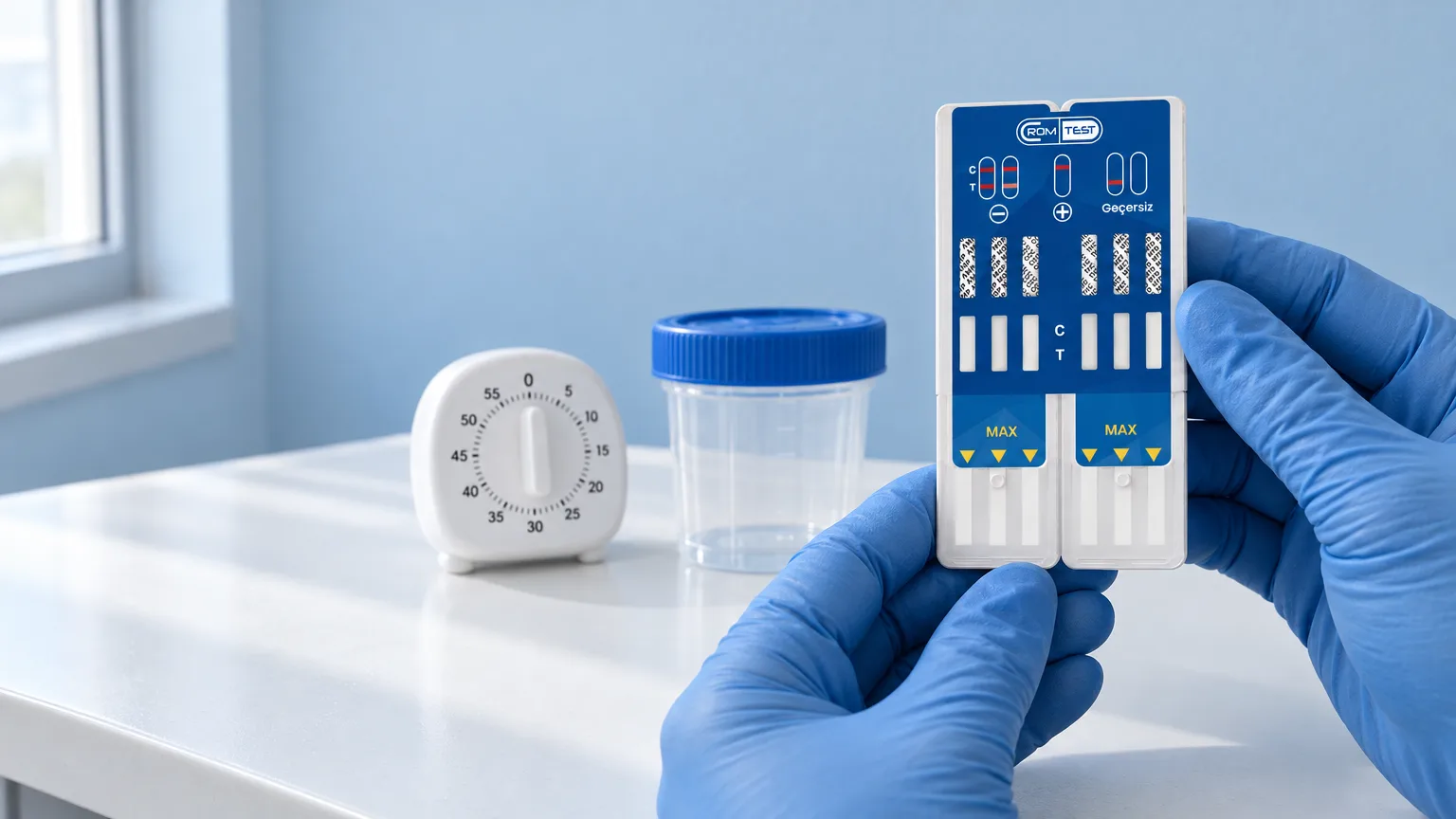
Result Types at a Glance
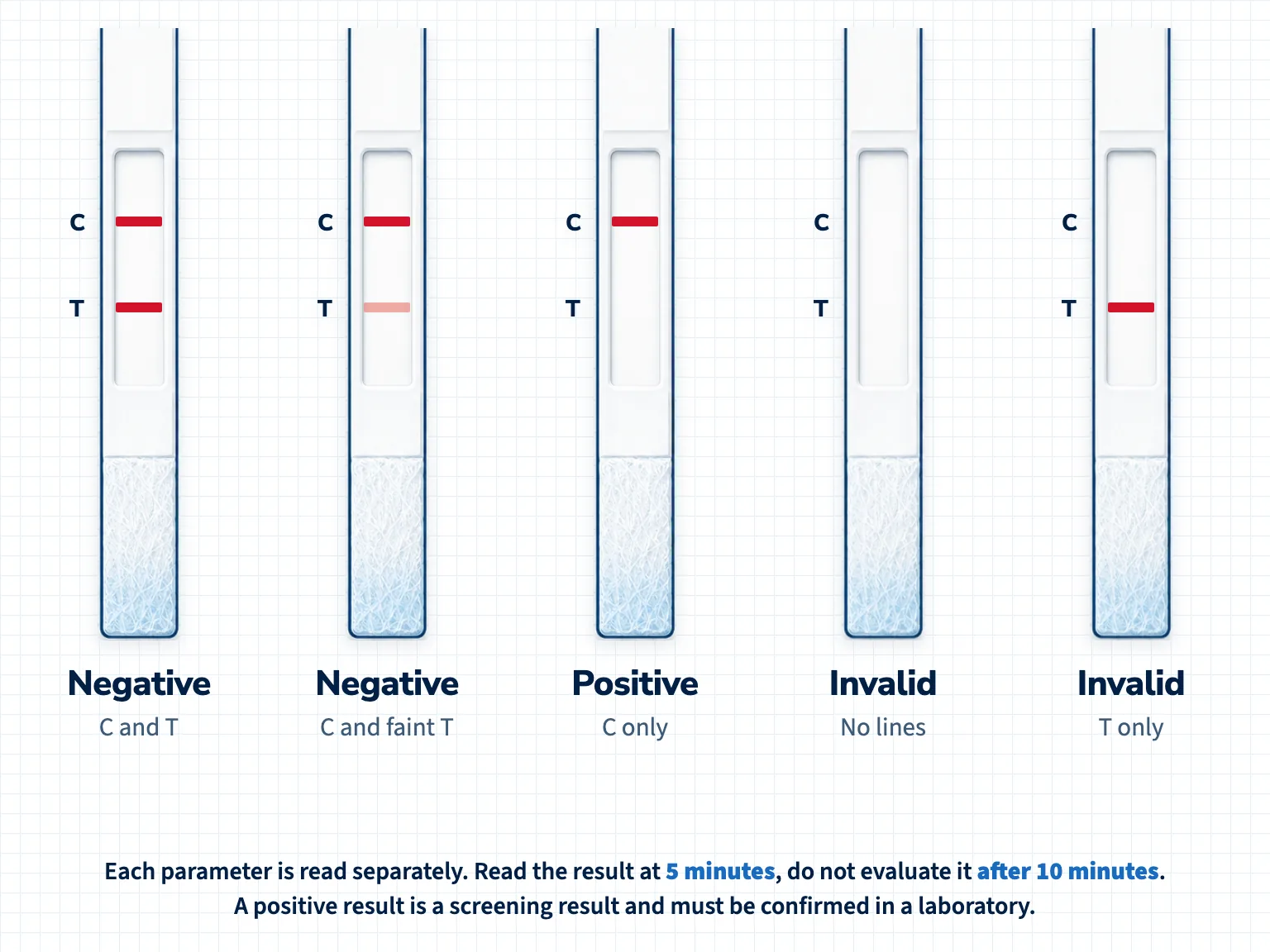
The four possible appearances of the lines on the test strip and what they mean are summarised below. On multi-panel kits these rules apply to each parameter separately.
| Appearance | Result | Meaning |
|---|---|---|
| One line each at C and T | Negative | The substance is absent from the sample or below the cut-off. |
| C line and a faint but coloured T line | Negative | A faint T line does not change the result. |
| C line only | Positive (preliminary) | Indicates that the sample may contain the substance above the cut-off. It must be confirmed in a laboratory. |
| No C line (with or without a T line) | Invalid | The result is not interpreted. Repeat the test with a new kit. |
What Do the C and T Lines Mean?
The result window of a test strip has two regions. The control region (C) shows whether the sample moved along the strip correctly. When enough sample has moved along the strip, a line must always form in this region, whether or not the sample contains the substance. The test region (T) gives the result for the substance being screened.
As our instructions for use state, the result is read from whether the lines are present and where they are.
Why Does One Line Mean Positive?
Many people know pregnancy tests, where two lines mean positive. Drug tests work the other way round, and the reason is how the test works.
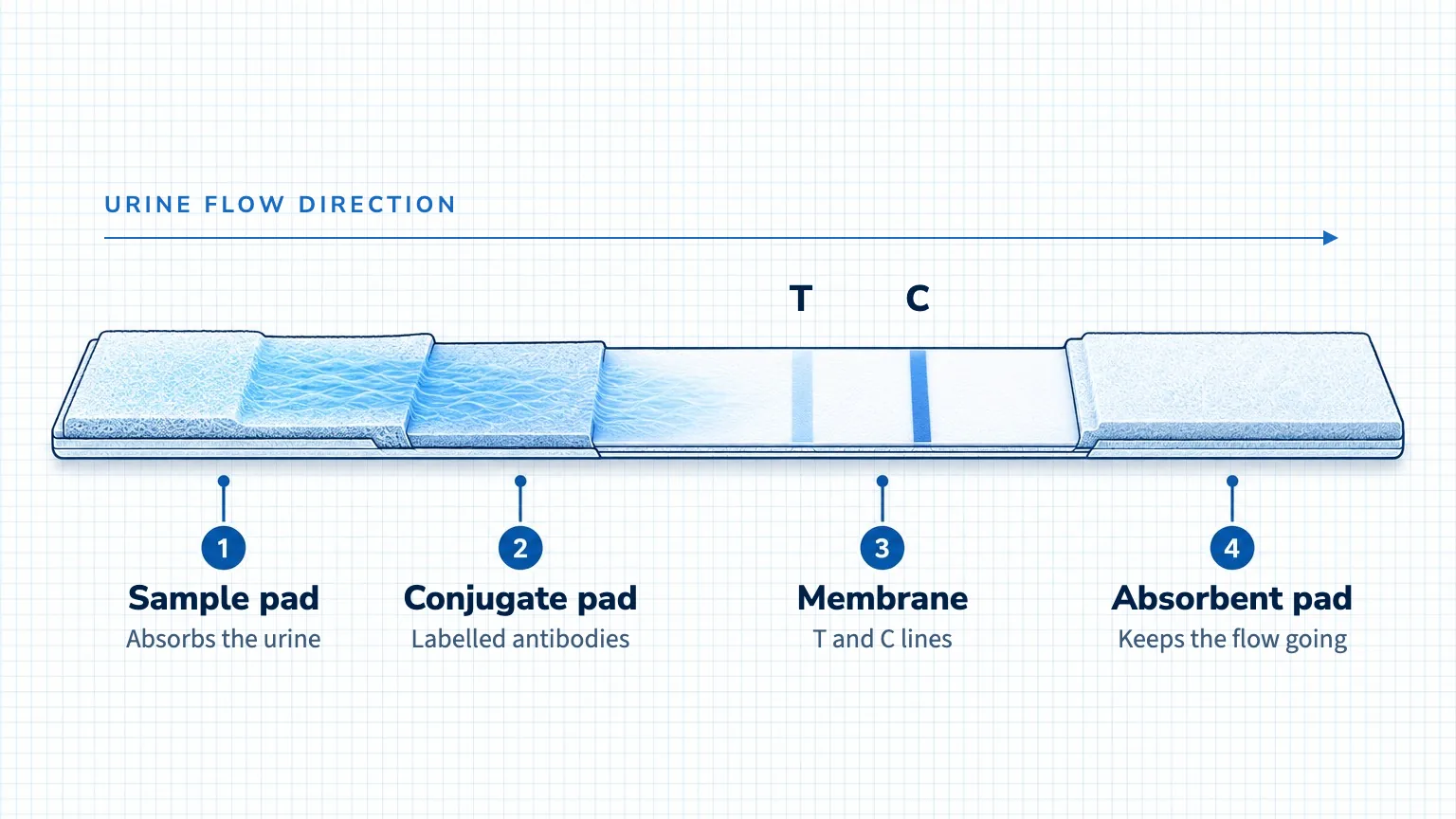
Rapid drug tests use a competitive immunochromatographic method. When urine is absorbed by the strip, it dissolves the labelled antibodies in the conjugate pad and carries them along the membrane. A look-alike of the screened substance is fixed in the T region. If the sample contains no substance, or the amount is below the cut-off, the antibodies bind to this look-alike in the T region and a coloured line forms. If the substance in the sample is above the cut-off, it fills the antibodies' binding sites. The antibodies then cannot attach in the T region, and no line forms there.
The line in the C region forms on every valid test, independent of the substance in the sample. So seeing only the C line indicates that the screened substance in the sample is above the cut-off.
What Does a Positive Result Mean?
A positive result shows that the screened substance, or its breakdown products in the body (metabolites), is present in the sample at a concentration above the test's cut-off. A rapid test is qualitative. So the result does not show how much was taken, when it was taken or whether the person was under the influence at the time.
The antibodies used in rapid tests can also react with other substances that have a similar chemical structure. Some medicines and substances can therefore lead to a positive screening result even if the person did not use the screened substance. A medicine prescribed by a doctor can also give a positive result for the related parameter. The U.S. Food and Drug Administration (FDA) states that a positive result caused by a prescription drug does not by itself mean that the drug is being misused.
Wait for the laboratory confirmation before making any serious decision based on a positive screening result. The FDA gives the same advice for drug tests used at home.
Is a Faint Line Positive?
If a faint but coloured line is visible in the test region, the result is read as negative. According to our instructions for use, the shade of the line in the T region can vary, but if even a lightly coloured line is visible, the result is negative.
The shade of the line does not give reliable information about the amount of substance in the sample.
A faint line can only be read as negative if these three conditions are met together:
- The C line must be visible: Without a control line the test is invalid, and the line in the T region is not evaluated.
- The line in the T region must be coloured: If you are not sure whether a line is there, laboratory confirmation of the result is recommended.
- The result must be read on time: The result is read from minute 5. Lines that appear or change after 10 minutes are not taken into account.
What Does a Negative Result Mean?
A negative result shows that the screened substance is absent from the sample or below the cut-off. So a negative result does not prove that the sample contains no substance at all. If the substance was taken very recently, it may not have reached the urine yet. If a long time has passed since the last use, the amount in the urine may have fallen below the cut-off. We explain how long substances can be detected in urine in our article Which Substances Show Up in Urine Tests, and for How Long?
Diluting the sample or adding a foreign substance to it can also make the result misleading. In workplace and clinical screening, the integrity of the sample is therefore checked with a separate test. Our Urine Integrity Test checks creatinine, nitrite, glutaraldehyde, pH, specific gravity and oxidants to show whether the sample has been diluted or tampered with.
Invalid Result: When No C Line Appears
If no line forms in the control (C) region, the test is invalid. This rule applies whether or not there is a line in the T region, because without the C line there is no way to tell that the sample moved along the strip correctly. An invalid test is not read as positive or negative.
According to our instructions, possible causes of an invalid result are too little sample or a test procedure that was not followed correctly. In that case, go through the steps again and repeat the test with a new kit. Tests that are past their expiry date or were not stored properly may also give incorrect results.
When Do You Read the Result?
For a reliable result, the reading time matters as much as the lines. The lines become clearer as the urine moves along the membrane. A reading taken before the waiting time is up can therefore be incomplete, and changes seen after 10 minutes do not reflect the test result.
For tests used with a urine sample, the steps in our instructions for use are, in short:
- Collect the urine sample in a clean sample cup.
- Dip the test cassette or strip into the urine in the direction of the arrow, up to the MAX line, and hold it there for 20 seconds.
- Place the test on a dry, flat surface and wait 5 minutes.
- Read the result from minute 5. Do not evaluate the result after 10 minutes.
You can find all steps with pictures, including use with solid samples, on our Instructions for Use page.
How Do You Read a Multi-Panel Test?
On multi-panel kits such as the Classic 6-Panel and Classic 12-Panel, each parameter is read in its own window, marked with its abbreviation on the cassette (such as AMP, THC or COC). Each window is read independently by the rules above.
For example, if only the C line is visible in the THC window and all other windows show two lines, the positive screening result applies to THC only. If no C line has formed in a window, the result for that parameter is invalid and the test should be repeated with a new kit.
If you want to screen for several substances in one go, our kit covers 12 parameters on a single cassette:
View the Classic 12-PanelHow Does the Cut-off Affect the Result?
The cut-off is the decision threshold at which the test separates a positive from a negative result. It is given in nanograms per millilitre (ng/mL). The test is designed to give a positive result when the concentration of the substance in the sample is above this threshold. Each parameter has its own cut-off, and tests from different manufacturers can use different values for the same substance. For example, the cut-off of our Pregabalin Test is 50 ng/mL.
Laboratory confirmation tests use other methods and often other cut-offs. So a rapid test result and a laboratory result do not always match one to one.
What Should You Do After a Positive Result?
- Do not treat the result as final: A rapid test is a screening step. No serious decision should be made on a positive screening result before the laboratory result is in.
- Report the medicines you take: Tell the organisation running the test, or the doctor assessing the result, about any prescription or over-the-counter medicines you take, and keep your prescription with you.
- Ask for laboratory confirmation: A positive screening result should be confirmed under the supervision of a health professional with a chromatographic method such as GC-MS or LC-MS/MS. Repeating the same or another rapid test does not replace a confirmation test.
- Follow the organisation's procedure: In workplace, clinic or rehabilitation centre screening, the sample is collected, stored and sent for confirmation according to the organisation's procedure.
Frequently Asked Questions
What does one line on a drug test mean?
If the single line is in the control (C) region, the result is a positive screening result for that substance. If the single line is only in the test (T) region, the test is invalid and must be repeated with a new kit.
Is a faint line on a drug test positive?
However faint the coloured line in the T region is, the test counts as negative as long as the C line is visible and the result was read on time.
Does a line that appears after 10 minutes count?
Under our instructions for use, the result is read from minute 5, and lines that appear or change after 10 minutes are not evaluated. Tests from other brands follow their own instructions.
Is a positive drug test result definite?
A positive result on a rapid test is a screening result. A definite result comes from a confirmation test in a laboratory.
Does the test show when or how much of a substance was used?
A rapid test does not show when, how often or how much was used. It only shows whether the concentration of the substance in the sample is above the cut-off.
Summary
On a rapid drug test, the position of the lines decides the result, not their number. On a valid test the C line is always visible, and no line in the T region indicates a positive screening result. To read the result correctly, follow the times in the instructions and have positive screening results confirmed in a laboratory.
Sources
- CROM TEST. Instructions for Use: applying multi-panel and single test kits and reading the results. cromtest.com/en/kullanim-kilavuzu.html, accessed October 8, 2026.
- U.S. Food and Drug Administration (FDA). Drugs of Abuse Home Use Test. fda.gov, accessed October 8, 2026.
- Moeller KE, Kissack JC, Atayee RS, Lee KC. Clinical Interpretation of Urine Drug Tests: What Clinicians Need to Know About Urine Drug Screens. Mayo Clin Proc. 2017;92(5):774-796. doi:10.1016/j.mayocp.2016.12.007
- Koczula KM, Gallotta A. Lateral flow assays. Essays Biochem. 2016;60(1):111-120. doi:10.1042/EBC20150012
- CROM TEST. Product information for the Urine Integrity Test (CRT-INT6-U05) and the Pregabalin Test (CRT-SP-PRE-U05), 2026.
This content is for information only. Clinical decisions should be based on analysis by an authorised laboratory.