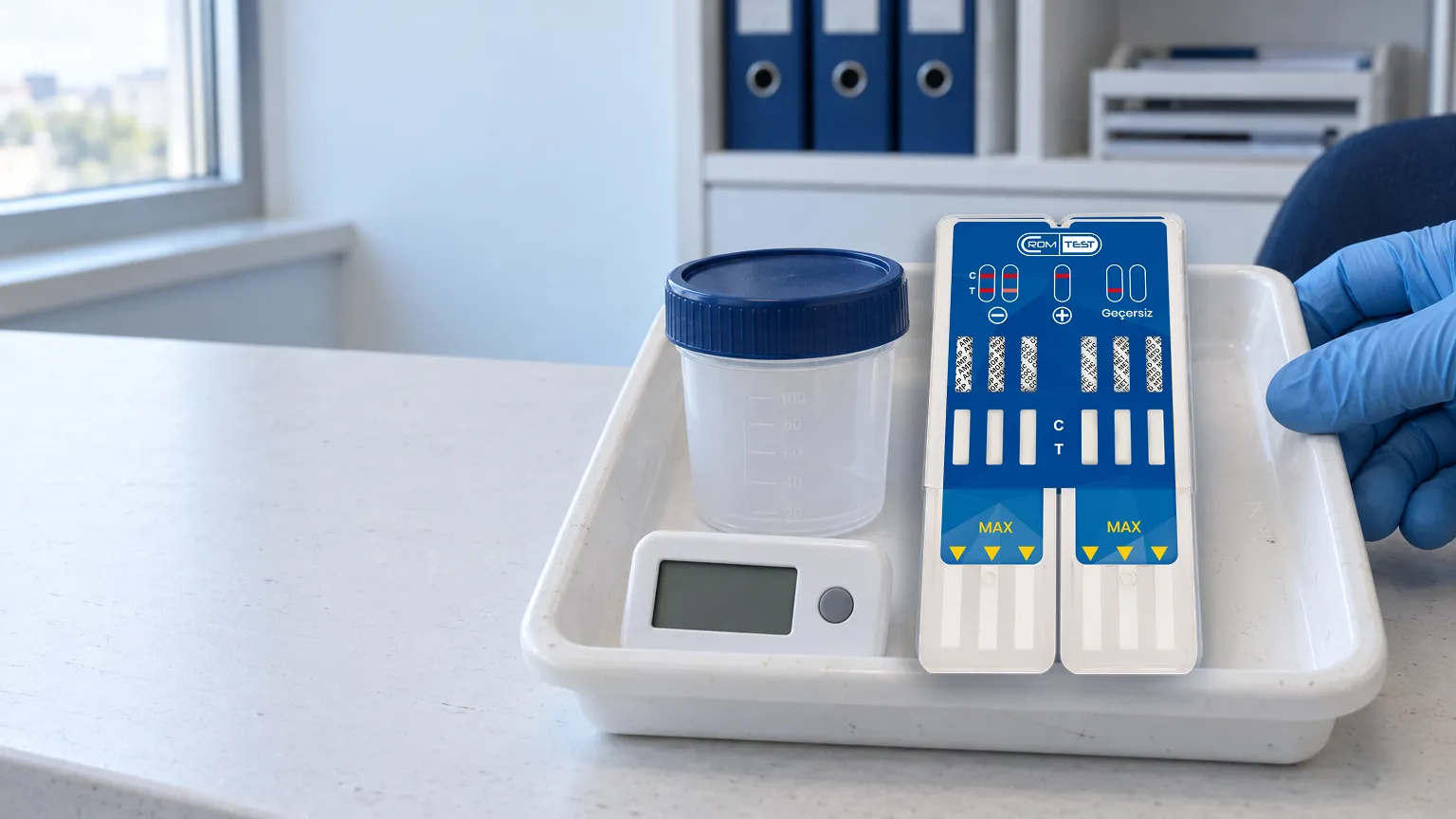
Methamphetamine, commonly known as "meth", "crystal" or "ice",[1] can usually be detected in urine tests for a few days after last use. In a controlled study with volunteers who took methamphetamine by mouth on four consecutive days, urine samples were positive for an average of 2 to 3 days, and at most about 4 days, after the last dose.[2]
Detection times by dose and cut-off
Most of the values below come from a controlled study in which volunteers took methamphetamine by mouth every day for four days. The samples were measured in the laboratory by GC-MS (gas chromatography-mass spectrometry), so the times in the table cannot be transferred one to one to rapid tests. Doses taken in illicit use are generally substantially higher than those in this study.[3]
| Dose and cut-off | Time observed in urine | Source |
|---|---|---|
| First positive sample after a single dose, 500 ng/mL | On average after 4 to 6 hours (range 1 to 11 hours) | [2] [4] |
| Four days, 10 mg per day, 500/200 ng/mL (methamphetamine/amphetamine) | Average 43.6 hours (about 2 days) until the last positive sample | [2] |
| Four days, 20 mg per day, 500/200 ng/mL | Average 66.9 hours (about 3 days), longest 91.7 hours | [2] |
| Same doses, 250/100 ng/mL | Average 2.5 to 3.3 days, longest 95.5 hours (about 4 days) | [2] |
| Regular and heavy use | With consecutive use, the substance accumulates and detection time increases. Controlled study data for this pattern of use are limited. | [5] |
The 500/200 ng/mL cut-offs in the table are the values used in the US to confirm workplace tests when the study was done. 250/100 ng/mL were the lower cut-offs proposed at that time.[4] The researchers concluded that urine samples were positive at a relatively high rate for up to 3 days after use stopped.[2] Laboratory methods that can measure levels as low as 2.5 ng/mL still found methamphetamine in urine 7 days after four days of low-dose use.[3] That measurement level is far below the cut-offs of rapid tests.
How is methamphetamine eliminated from the body?
The half-life of methamphetamine in blood is about 10 hours, but it varies markedly from person to person (3 to 17 hours after oral intake).[3] The liver breaks down most of the substance, and part of it is converted to amphetamine. In the first 24 hours, about 30 to 50% of the dose is excreted in urine unchanged and about 10% as amphetamine.[3]
The final phase of excretion in urine is slower than in blood. In this phase the half-life calculated from urine measurements is about 24 hours. When it is used on several consecutive days, the substance therefore accumulates and the detection time gets longer.[5]
In the controlled study, methamphetamine reached the cut-off in urine within a few hours of the first dose. The amphetamine formed from it reached the 200 ng/mL cut-off after 14 hours on average.[2] This delay may explain why the MET and AMP regions described below are not always positive at the same time.
Factors that affect detection time
- Dose and frequency of use. In the controlled study, doubling the dose lengthened the average time to the last positive sample by about one day.[2] Consecutive use lengthens it further because the substance accumulates.[5]
- The test's cut-off. A lower cut-off also picks up smaller amounts. In the same people, halving the cut-off lengthened the detection time by up to 24 hours.[4]
- Urine acidity (pH). How fast methamphetamine is excreted depends on urine pH, and excretion speeds up when the urine is acidic.[3] Detection time can therefore differ between people even at the same dose.
- Urine concentration. How dilute or concentrated the urine is affects the measured concentration of the substance.[2] An overly dilute sample makes the result less reliable, and the Urine Integrity Test can identify it.[8]
- Individual differences. In the study, the time to the last positive sample ranged from 46 to 92 hours among people who took the same dose.[2] No one's result can therefore be predicted with certainty in advance.
How does the cut-off affect the result?
Screening tests are made to give a positive result once the amount of substance in urine rises above a set limit, called the cut-off. In the US federal rules for workplace testing, the initial screening cut-off for amphetamine and methamphetamine is 500 ng/mL and the laboratory confirmation cut-off is 250 ng/mL.[6] The 2017 guideline of the European Workplace Drug Testing Society (EWDTS) recommends 500 ng/mL for screening and 200 ng/mL for confirmation.[7]
In the same person, a test with a higher cut-off turns negative sooner, and a test with a lower cut-off stays positive longer. So if two different tests give different results on the same day, that does not necessarily mean one of them is wrong.
In our Methamphetamine Test and in the MET section of the Classic 6 Panel and Classic 12 Panel kits, the cut-off is 500 ng/mL in urine, according to our instructions for use.[8]
Why can the MET and AMP regions on a panel be positive together?
Urine test panels have separate test regions for methamphetamine (MET) and amphetamine (AMP). Because the body converts part of the methamphetamine to amphetamine, the AMP region can also be positive after meth use.[3] Whether it is depends on the cut-off of the AMP region and on the cross-reactivity stated in the instructions for use. In the first hours after use, however, only the MET region may be expected to be positive, because amphetamine builds up in urine later.[2]
A positive AMP region on its own may not indicate methamphetamine use. It can come from amphetamine use or from some of the medicines covered below. To screen for both substances, choose a panel with AMP and MET regions.
Do medicines affect amphetamine and methamphetamine tests?
Rapid tests detect the substance with an antibody-based method (immunochromatography). Some medicines with a similar chemical structure can react with these antibodies and lead to a positive result. Which medicine affects which test depends on that test's own cross-reactivity, so go by the list in the instructions for use inside the box.
The main medicines that the literature has linked to a positive amphetamine or methamphetamine screen without illicit use are:
- Selegiline, a medicine used to treat Parkinson's disease, is converted in the body to l-methamphetamine and l-amphetamine. In a case report, the urine of a person taking selegiline was positive on a methamphetamine rapid test.[9]
- Some decongestant nasal inhalers sold over the counter in the US contain l-methamphetamine (levmetamfetamine). A study examined recommended-dose use of such an inhaler (Vicks VapoInhaler, which contained levmetamfetamine in 2014); 2.2% of samples were positive on an amphetamine screening test.[10]
- Pseudoephedrine, an active ingredient in cold medicines, has caused false positive results on some amphetamine screening tests.[11]
- Bupropion, used for depression and to help people stop smoking, was judged the most common cause of unconfirmed amphetamine positives in one hospital.[12]
Special (chiral) analyses, done in the laboratory on request, can tell the d and l forms of methamphetamine apart. This helps determine whether the result comes from a medicine or from illicit use.[9] If you take a medicine your doctor recommended, it helps to tell the person doing the test beforehand. We do not recommend stopping a prescription medicine just because you are going to be tested.
Detection in blood, saliva and hair
- In oral fluid (saliva), the controlled study detected methamphetamine at a 50 ng/mL cut-off for between a few hours and about one day after the oral doses.[2]
- In blood, methamphetamine could usually be measured for 36 to 48 hours after a single 10 mg intravenous dose.[3]
- In hair, a study that followed 63 people who had used methamphetamine for a long time found that in most of them the hair test stayed positive for about 90 days after the reported date they stopped. After 153 days all results were negative.[13]
The test kits mentioned in this article are used with a urine sample.
Which test kit should you choose?
Methamphetamine Test
A single-substance test strip used with a urine sample, suitable when only methamphetamine is to be screened.
5 tests · Urine
View ProductClassic 6 Panel
Screens methamphetamine and amphetamine together with cocaine, cannabis (THC), morphine and methadone in the same urine sample.
1 unit · Urine
View ProductClassic 12 Panel
Screens ecstasy (MDMA), benzodiazepines, barbiturates, buprenorphine, PCP and tricyclic antidepressants in addition to these six substances.
1 unit · Urine
View ProductHow is the urine test performed?
The steps below follow the instructions for urine samples in our instructions for use.[8] We recommend reading the instructions for use inside the box before doing the test.
- Collect the urine in the sample cup. Make sure the sample is not mixed with other substances and that there is enough of it.
- Dip the test:
- Test strip (Methamphetamine Test): take the strip out of its packaging, dip it into the urine sample up to the MAX line and wait 20 seconds.
- Test cassette (Classic 6 Panel and Classic 12 Panel): take the cassette out of its packaging and remove the caps at the bottom. Dip it into the urine sample in the direction of the arrow, up to the MAX line, and wait 20 seconds. Then close the cassette's cap.
- Place the test on a dry, flat surface and wait 5 minutes.
- Read the result from minute 5. Do not evaluate it after 10 minutes have passed.
How to read the control (C) and test (T) lines is explained in detail in our article What does a positive drug test mean?
What to do after a positive result
Rapid tests quickly show which samples need to go to a laboratory. Negative samples often need no laboratory costs or waiting. A positive screening result indicates that methamphetamine is present in urine above the cut-off, but it is not definite on its own. Positive results should be confirmed with chromatographic laboratory methods such as GC-MS or LC-MS/MS under the supervision of a health professional.
In institutional screening, the Urine Integrity Test can be used to check the reliability of the sample. It measures creatinine, nitrite, glutaraldehyde, pH, specific gravity and oxidant values to determine whether the sample has been diluted or tampered with afterwards.
Conclusion
Methamphetamine can mostly be detected in urine for a few days. According to controlled study data, after low doses taken on four consecutive days this time is 2 to 3 days on average. It can be longer with higher doses and long-term use. The main factors that determine it are dose, frequency of use, urine acidity and the test's cut-off. On panel tests, reading the MET and AMP regions together and taking medicine use into account helps interpret the result correctly.
Classic 6 Panel
Classic 6 Panel screens 6 substances, including methamphetamine and amphetamine, in a single urine sample and gives a result in 5 minutes.
For wider screening: Classic 12 Panel · For methamphetamine only: Methamphetamine Test
Frequently asked questions
How many days does meth stay in urine?
In volunteers who took methamphetamine by mouth on four consecutive days, urine mostly stayed positive for 2 to 3 days, and at most about 4 days, after the last dose.[2] The time can be longer with higher doses and more frequent use.[5]
Does crystal or ice show up as meth on a urine test?
Crystal and ice are street names for methamphetamine.[1] A urine test responds to methamphetamine in urine, not its street name. Crystal or ice use therefore shows in the MET region of the test, and the detection time is the same.
How many hours after using meth does it show up on a urine test?
In a controlled study, methamphetamine in urine reached the 500 ng/mL cut-off on average 4 to 6 hours after a single dose. The time ranged from 1 to 11 hours depending on the person.[2]
How long can methamphetamine be detected in blood?
Its half-life in blood is about 10 hours. After a single 10 mg intravenous dose, methamphetamine could usually be measured in blood for 36 to 48 hours.[3]
Does a dilute urine sample affect the test result?
An overly dilute urine sample makes the screening result less reliable, so workplace and institutional testing checks separately whether the sample is dilute. The Urine Integrity Test, which measures creatinine and specific gravity, helps identify dilute samples.[8]
Does cold medicine affect an amphetamine or meth test?
Some cold medicines containing pseudoephedrine have been reported to cause false positive results on some amphetamine screening tests.[11] The effect varies with the test's antibody, so check the cross-reactivity list in the instructions for use of the test you are using.
Is a positive meth test definite?
A positive rapid test result is a preliminary screening finding and is not definite on its own. It needs to be confirmed with a laboratory method such as GC-MS or LC-MS/MS.
Which test kits screen for methamphetamine?
Methamphetamine can be screened in urine with single-substance test strips or with multi-panel tests that have a MET region. Our Methamphetamine Test, Classic 6 Panel and Classic 12 Panel are used for this.[8]
Sources
- Turkish Ministry of Interior, General Directorate of Security. Asla Met Kullanma. egm.gov.tr (accessed 2 November 2026).
- Huestis MA, Cone EJ. Methamphetamine disposition in oral fluid, plasma, and urine. Ann N Y Acad Sci. 2007;1098:104-121. PMID: 17332086.
- Cruickshank CC, Dyer KR. A review of the clinical pharmacology of methamphetamine. Addiction. 2009;104(7):1085-1099. PMID: 19426289.
- Oyler JM, Cone EJ, Joseph RE Jr, Moolchan ET, Huestis MA. Duration of detectable methamphetamine and amphetamine excretion in urine after controlled oral administration of methamphetamine to humans. Clin Chem. 2002;48(10):1703-1714. PMID: 12324487.
- Kim I, Oyler JM, Moolchan ET, Cone EJ, Huestis MA. Urinary pharmacokinetics of methamphetamine and its metabolite, amphetamine following controlled oral administration to humans. Ther Drug Monit. 2004;26(6):664-672. PMID: 15570192.
- Substance Abuse and Mental Health Services Administration. Mandatory Guidelines for Federal Workplace Drug Testing Programs: Authorized Testing Panels. Federal Register. 2026;91(49):12308-12311. Official text.
- Taskinen S, Beck O, Bosch T, et al. European guidelines for workplace drug testing in urine. Drug Test Anal. 2017;9(6):853-865. PMID: 28267298.
- CROM TEST instructions for use, product pages and manufacturer information (MET cut-off): Methamphetamine Test, Classic 6 Panel, Classic 12 Panel, Urine Integrity Test (accessed 30 October 2026).
- Shin I, Choi H, Kang S, et al. Detection of l-methamphetamine and l-amphetamine as selegiline metabolites. J Anal Toxicol. 2021;45(1):99-104. PMID: 32476010.
- Smith ML, Nichols DC, Underwood P, et al. Methamphetamine and amphetamine isomer concentrations in human urine following controlled Vicks VapoInhaler administration. J Anal Toxicol. 2014;38(8):524-527. PMID: 25217541.
- Stout PR, Klette KL, Horn CK. Evaluation of ephedrine, pseudoephedrine and phenylpropanolamine concentrations in human urine samples and a comparison of the specificity of DRI amphetamines and Abuscreen online (KIMS) amphetamines screening immunoassays. J Forensic Sci. 2004;49(1):160-164. PMID: 14979364.
- Casey ER, Scott MG, Tang S, Mullins ME. Frequency of false positive amphetamine screens due to bupropion using the Syva EMIT II immunoassay. J Med Toxicol. 2011;7(2):105-108. PMID: 21191682.
- Suwannachom N, Thananchai T, Junkuy A, O'Brien TE, Sribanditmongkol P. Duration of detection of methamphetamine in hair after abstinence. Forensic Sci Int. 2015;254:80-86. PMID: 26197350.
This content is for information only. Clinical decision-making should rest on analysis by an authorised laboratory.