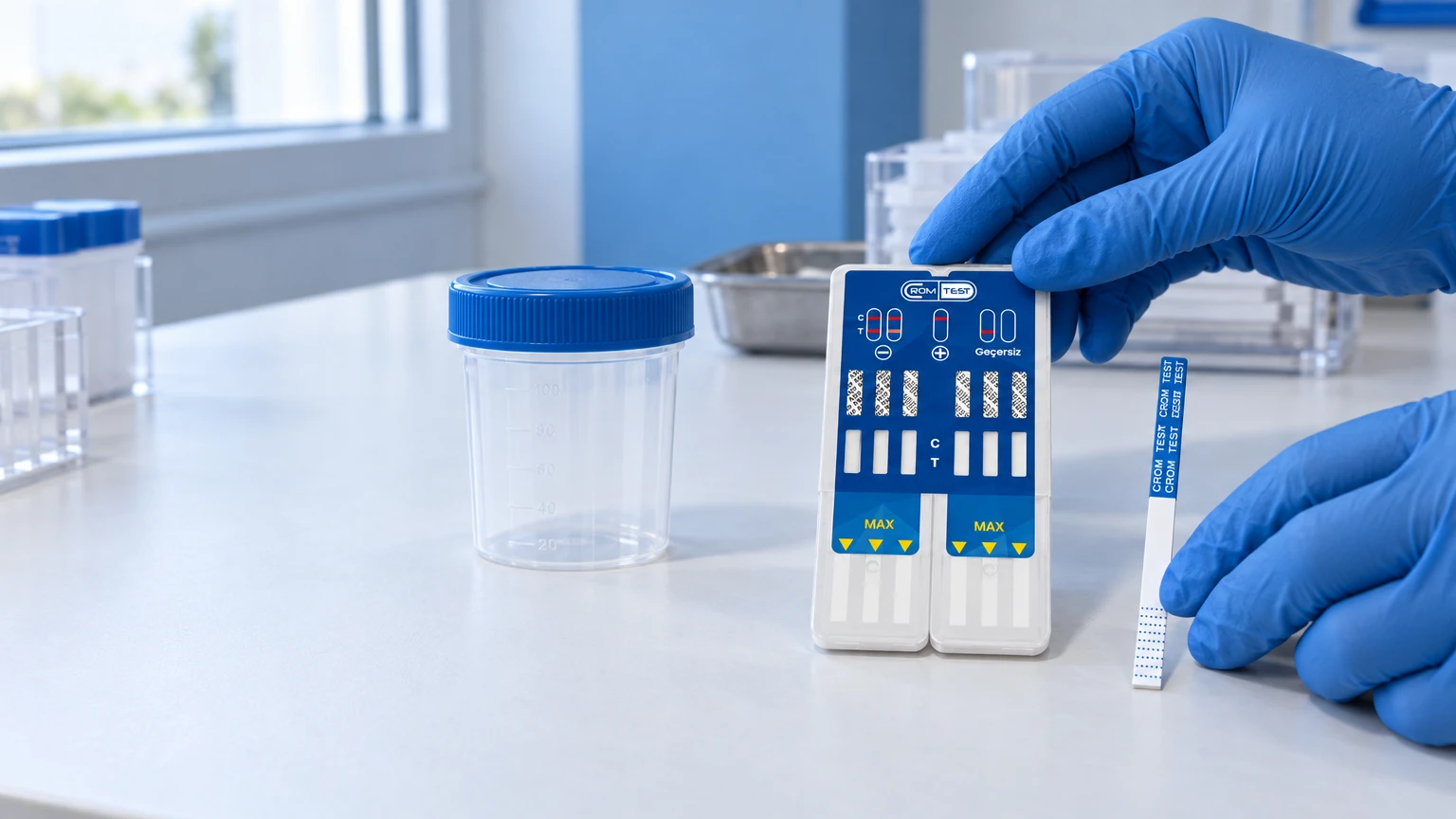
Cannabis detection time in urine varies with the pattern of use and the test cut-off. In a controlled study, screening tests with a 50 ng/mL cut-off stayed positive for less than 2 days on average after a single use.[1] With regular, long-term use, the time can extend to weeks.[3]
Detection times by pattern of use
The values below come from studies in which participants were kept under supervision in clinical research units. The studies used immunological screening tests (immunoassays) performed in a laboratory. Detection time differs from person to person, so nobody can predict a particular person's test result with certainty in advance.
| Pattern of use | Time observed in the urine test | Source |
|---|---|---|
| Single use, 50 ng/mL cut-off | Less than 1 day on average at a low dose, less than 2 days at a high dose | [1] |
| Single use, 20 ng/mL cut-off | 1 to 5 days on average at a low dose, 3 to 6 days at a high dose | [1] |
| Regular use, ranging from daily to weekly, 50 ng/mL cut-off | 4.3 to 15.4 days on average until the last positive sample (depending on the initial level in urine) | [2] |
| Chronic use | At a 20 ng/mL cut-off, continuously positive for up to 46 days in some people; mean excretion time 27 days | [3] |
Times observed with laboratory immunological screening tests in supervised participants.
The two most important factors in the table are how often cannabis is used and the cut-off of the test. In the same person, a test with a lower cut-off can stay positive for longer.
Why can cannabis be detected for so long?
Urine tests do not detect cannabis itself. They detect THC-COOH, a metabolite that forms when the body breaks down THC (tetrahydrocannabinol) and that is excreted in urine. As Goodwin and colleagues also note, THC is fat soluble, so it distributes into fat tissue and, with frequent use, is stored there.[2] After use stops, THC is slowly released from this store back into the blood, and this slow release sets the rate of excretion.
The release does not happen at the same rate every day. Ellis and colleagues followed 86 chronic users and saw that excretion ran in two phases. A rapid fall in the first period was followed by fluctuating values, and most participants tested positive again after negative periods that lasted 3 days on average.[3]
Factors that affect detection time
- Frequency and amount of use. After a single use the time is short. With regular use it becomes markedly longer because THC builds up in fat tissue.
- The cut-off of the test. The lower the cut-off, the smaller the amounts the test can detect, and the longer the detection time.
- The initial level in urine. In the 60-person study by Goodwin and colleagues, people with a high THC-COOH level in their first urine sample took markedly longer to reach their last positive result.[2]
- Body mass index (BMI). The same study found that the time until the last positive sample grew longer as BMI increased.[2] However, Ellis and colleagues reported that factors such as body build and history of use have limited value for predicting detection time.[3] An exact time therefore cannot be calculated from these factors.
How does the cut-off affect the result?
Screening tests are made to give a positive result once the amount of a substance in urine rises above a set limit. This limit is called the cut-off. Urine screening for THC uses different cut-offs, such as 20, 50, 75 and 100 ng/mL.
The controlled study by Huestis and colleagues showed that samples taken from the same people after the same use stayed positive for very different times depending on the cut-off. At a 100 ng/mL cut-off the mean time was at most 1.5 days, while at a 20 ng/mL cut-off it rose to between 1 and 6 days. The researchers concluded that an immunological test with a 50 ng/mL cut-off can detect a single use within a narrow window of about 1 to 2 days. The same study also stresses that every immunological test has its own sensitivity.[1]
The laboratory confirmation test (GC-MS) measures much lower amounts. In this study, the detection time measured with GC-MS at a 15 ng/mL cut-off was about twice that of the screening test with a 50 ng/mL cut-off.[1]
According to the instructions for use, the CROM TEST THC Test and the THC test in the Classic 12 Panel work with a cut-off of 50 ng/mL in urine.[7] The studies above used tests performed in a laboratory, so their times cannot be transferred one to one to rapid tests.
Why is a single negative result not enough?
After long-term use, a single negative result may not mean that the substance has left the body completely. Because of the fluctuating excretion described above, chronic users can test positive again after negative results. In institutional monitoring programmes or monitoring within a family, this finding suggests that testing at regular intervals may give a more accurate picture than relying on a single result.
According to Goodwin and colleagues, their data help set appropriate detection intervals.[2] These intervals are needed to tell new use apart from ongoing excretion of earlier use. Judging whether a result shows new use requires expert interpretation based on laboratory measurement.
Does passive smoking make a urine test positive?
In an experiment by Cone and colleagues, six participants who do not use cannabis sat in the same closed room as people smoking cannabis. Under these extreme exposure conditions there were no positive results at all at the 100 and 75 ng/mL cut-offs. At the 50 ng/mL cut-off only one sample was positive, and at the 20 ng/mL cut-off more than one. Ventilating the room markedly reduced exposure.[4]
The researchers concluded that positive results from passive exposure are probably rare, would be limited to the hours immediately after exposure, and could occur only where the exposure is clearly noticeable.
Saliva and blood tests
Other sample types detect a different substance over a different time:
- Saliva (oral fluid). In a study of people who used cannabis every day, THC could generally be measured for 48 hours after use stopped. This time depends on the laboratory method and the cut-off used.[5]
- Blood. Some people who had used cannabis heavily for a long time still had measurable THC in their blood days after stopping. According to the researchers, it is not yet known whether a low THC level in blood shows that a person is under the influence.[6]
The test kits mentioned in this article are used with a urine sample, not saliva or blood.
How to do a urine test
The steps below follow the urine-sample instructions in our instructions for use.[7] We recommend reading the instructions for use in the box before doing the test.
- Prepare the sample. Collect the urine in the sample cup. Make sure the sample is not mixed with other substances and that there is enough of it.
- Dip the test strip (THC Test). Take the test strip out of its packaging, dip it into the urine sample up to the MAX line and wait 20 seconds.
- Dip the test cassette (Classic 12 Panel). Take the test cassette out of its packaging and remove the caps at the bottom. Dip the cassette into the urine sample in the direction of the arrow, up to the MAX line, and wait 20 seconds. Then close the cassette's cap.
- Wait. Place the test on a dry, flat surface and wait 5 minutes.
- Read. Read the result from minute 5. Do not evaluate the result once 10 minutes have passed.
How to read the control (C) and test (T) lines is explained in detail in our article What does a positive drug test mean?
What to do after a positive result
Rapid tests are used for preliminary screening in clinical assessment. A positive screening result shows that the urine contains THC metabolite above the cut-off, but on its own it is not a definitive result. Positive results should be confirmed with chromatographic laboratory methods such as GC-MS or LC-MS/MS under the supervision of a health professional.
In institutional screening, the Urine Integrity Test can be used to check that a sample is reliable. It measures creatinine, nitrite, glutaraldehyde, pH, specific gravity and oxidant values to determine whether the sample has been diluted or tampered with to affect the result.
Conclusion
After a single use, the detection time of cannabis in urine is limited to a few days; in people who use it frequently, it can reach a few weeks. The main factors that set the time are frequency of use and the cut-off of the test. Testing at regular intervals rather than relying on a single result, and having positive results confirmed in a laboratory, provides a more reliable assessment.
Classic 12 Panel
The Classic 12 Panel screens 12 substances, including THC, from a single urine sample and gives a result in 5 minutes.
For cannabis screening only: THC Test
Frequently asked questions
How many days can a urine test be positive after a single use?
In a controlled study, laboratory screening tests with a 50 ng/mL cut-off stayed positive for less than 2 days on average. With 20 ng/mL tests, which have a lower cut-off, the average time extended to up to 6 days.[1] This time can vary from person to person.
How long does a regular cannabis user's test stay positive?
In a study of people who used cannabis anywhere from daily to weekly, laboratory screening at a 50 ng/mL cut-off gave an average time to the last positive result of 4 to 15 days, depending on the initial level in urine.[2] In another study of chronic users, some people's tests stayed continuously positive for up to 46 days at a 20 ng/mL cut-off.[3]
Is a dilute urine sample valid?
A dilute sample does not give a reliable result and may not be accepted as valid in institutional screening. The Urine Integrity Test detects a diluted sample from values such as low creatinine and a specific gravity outside the normal range.
Does being where cannabis is smoked make the test positive?
According to one study, this is probably rare. In an experiment with extreme exposure in a closed room, only one positive result appeared at the 50 ng/mL cut-off, and positive results were limited to the hours immediately after exposure.[4]
Does a negative test show that cannabis has left the body completely?
A negative result does not always show that cannabis has left the body completely. Long-term users can test positive again after negative results, so testing at regular intervals may give a more accurate picture for monitoring than a single result.
Which test kits detect cannabis (THC)?
For cannabis screening you can use the THC Test, which screens for THC only, or the Classic 12 Panel, which screens for THC and 11 other substances in the same urine sample.[7]
When should the THC Test result be read?
With the THC Test and the Classic 12 Panel, read the result between minute 5 and minute 10.[7]
Sources
- Huestis MA, Mitchell JM, Cone EJ. Detection times of marijuana metabolites in urine by immunoassay and GC-MS. J Anal Toxicol. 1995;19(6):443-449. PMID: 8926739.
- Goodwin RS, Darwin WD, Chiang CN, et al. Urinary elimination of 11-nor-9-carboxy-Δ9-tetrahydrocannabinol in cannabis users during continuously monitored abstinence. J Anal Toxicol. 2008;32(8):562-569. PMID: 19007504.
- Ellis GM Jr, Mann MA, Judson BA, et al. Excretion patterns of cannabinoid metabolites after last use in a group of chronic users. Clin Pharmacol Ther. 1985;38(5):572-578. PMID: 3902318.
- Cone EJ, Bigelow GE, Herrmann ES, et al. Non-smoker exposure to secondhand cannabis smoke. I. Urine screening and confirmation results. J Anal Toxicol. 2015;39(1):1-12. PMID: 25326203.
- Lee D, Milman G, Barnes AJ, et al. Oral fluid cannabinoids in chronic, daily cannabis smokers during sustained, monitored abstinence. Clin Chem. 2011;57(8):1127-1136. PMID: 21677094.
- Karschner EL, Schwilke EW, Lowe RH, et al. Do Δ9-tetrahydrocannabinol concentrations indicate recent use in chronic cannabis users? Addiction. 2009;104(12):2041-2048. PMID: 19804462.
- CROM TEST usage guide and product pages: THC Test, Classic 12 Panel, Urine Integrity Test (accessed 9 October 2026).
This content is for information only. Clinical decisions should rest on analysis by an authorised laboratory.